EV Range with Bowlus – Comparing EV Tow Vehicles
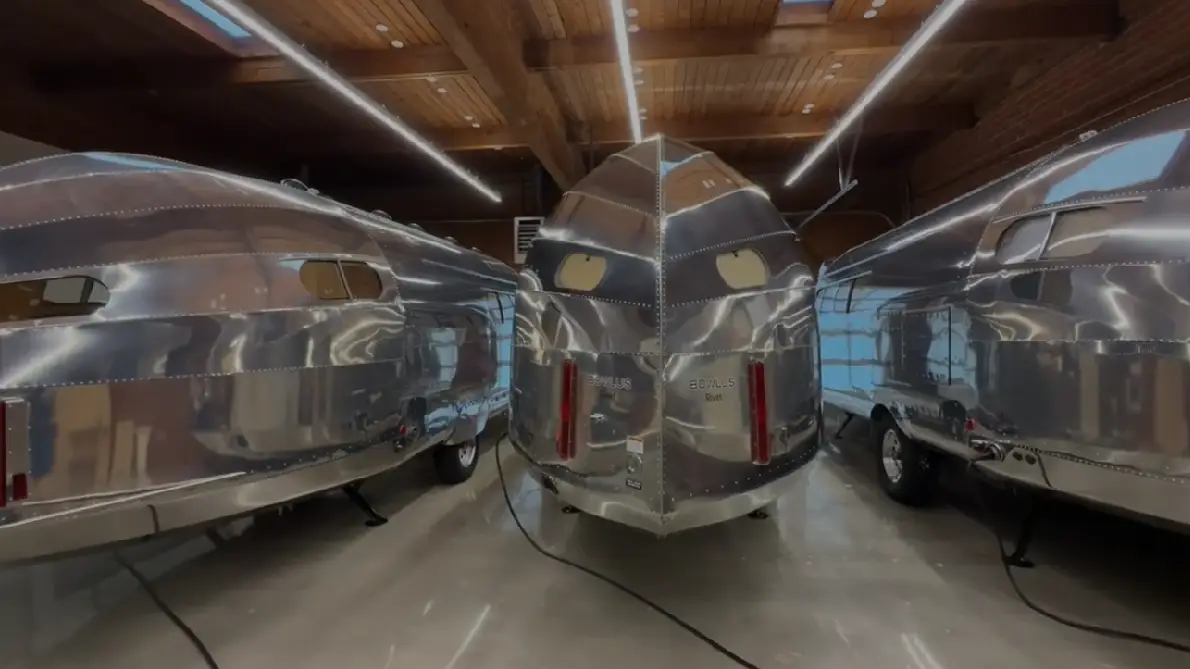
Is an electric vehicle a viable option for towing? The answer is yes—if you have a lightweight, aerodynamic travel trailer like the Bowlus!
In this video, we test and compare the range of three all-electric vehicles towing a Bowlus Volterra: a 2020 Tesla Model X Long Range Plus, a 2024 Tesla Cybertruck Dual Motor AWD, and a 2022 Rivian R1S Quad Motor AWD.
The Test:
We drove each EV towing a 2024 Bowlus Volterra (27’2″ overall length, 3,200 lbs dry weight) on a 103-mile route at 55 mph, climbing 600 ft from Santa Barbara, CA to Buellton, CA and back.
Results:
Tesla Model X: 419 Wh/mi, 2.39 mi/kWh, range of 238.6 miles per charge
Tesla Cybertruck: 538 Wh/mi, 1.86 mi/kWh, range of 228.6 miles per charge
Rivian R1S: 554 Wh/mi, 1.81 mi/kWh, range of 244 miles per charge
Despite the Cybertruck’s larger battery pack, the Tesla Model X outperformed it in range, but all three vehicles proved to be excellent options for all-electric camping road trips. In our opinion, the minimum range for a successful electric road trip is 200 miles per charge. This allows for flexibility when navigating charging stations and ensures you’re not cutting it too close between stops, making for a comfortable, stress-free journey.
The key to making all-electric towing feasible is pairing your EV with an ultra-lightweight, aerodynamic trailer like the Bowlus. Bowlus trailers deliver the best towing performance of any full-size travel trailer—better than even the most advanced concept vehicles with ‘self-propulsion.’
FAQs
Video Transcript
Hi, I’m Geneva Long, CEO of Bowlus, and today we’re going to be talking about how much EV range you actually need to have a reasonable zero-emissions camping trip. While EVs are now viable tow vehicles, this is only true if you are pulling an ultra-lightweight and aerodynamic trailer like a Bowlus. To prove this, we tested a 27-foot Bowlus (4,000 lbs GVWR) across a 103-mile route from Santa Barbara to Buellton and back, involving a 600-foot climb. We tested the Tesla Model X, the Tesla Cybertruck, and the Rivian R1S to see how they compared in real-world conditions.
Our results showed that the Tesla Model X led in efficiency, consuming 419 Wh/mile (2.39 miles/kWh) for a total range of 238.5 miles. The Cybertruck consumed 538 Wh/mile (1.86 miles/kWh), resulting in 228.5 miles of range, while the Rivian R1S consumed 554 Wh/mile (1.81 miles/kWh), giving it the highest total range at 244 miles due to its larger battery pack. Interestingly, the Model X outperformed the Cybertruck in overall efficiency, confirming that aerodynamics often matter as much as battery size. Despite these differences, all three vehicles proved to be excellent choices for all-electric camping.
In our experience, the minimum range required for a successful all-electric road trip is 200 miles per charge. This is because charging stations are often unevenly spaced; during our cross-country trips, we’ve encountered gaps as large as 186 miles between stations. Furthermore, a 200-mile interval represents a natural break in highway driving—about the perfect amount of time to stretch your legs or grab a coffee without feeling like you are stopping too frequently. We have officially crossed the threshold where EV towing is practical, provided your trailer is designed for it.
Bowlus offers the best towing rates of any full-size travel trailer, outperforming even “self-propelled” prototypes or concepts. This is due to our superior aerodynamics and lightweight design. We are excited to continue the conversation about the future of electric travel and invite you to reach out to our sales team at Bowlus of California. You can visit us at www.bowlus.com, email sales@bowlus.com, or call us at 805-568-7452.