Bowlus Feature Highlight: Air Conditioning
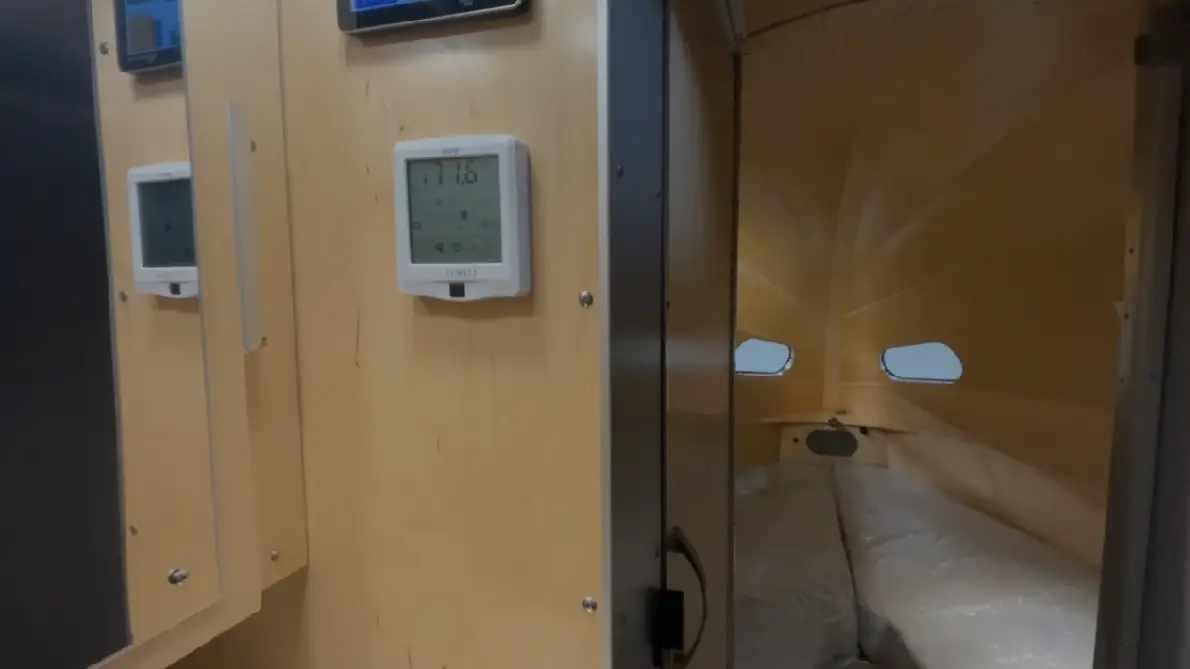
Join Geneva Long, CEO of Bowlus, as she talks about air conditioner design in RVs and showcases the air condition performance in the Bowlus.
During the display, we go from a temperature of over 102 degrees to 68 degrees off-grid from the Bowlus Power Management System.
FAQs
Video Transcript
Hi, I’m Geneva Long, CEO of Bowlus, and today we’re going to talk all about air conditioning inside RVs, and specifically the air conditioner of the Bowlus.
On most RVs, you’ll find the air conditioner on the roof. We don’t do this because it severely compromises aerodynamics and raises the center of gravity. When you raise the center of gravity, it causes worse handling, which often requires a weight equalization hitch or anti-sway bars. Bowlus solves this design problem by putting the air conditioner inside the shell. This keeps our center of gravity extremely low and our handling superb. It also means you aren’t required to have specialized hitches; you just need a standard 2-inch ball. This allows you to tow with a wider range of vehicles, including EVs.
It’s important to choose the right air conditioner for the space. If you choose a unit with too much cooling power, it will cycle off too quickly, failing to properly remove moisture from the air, and it may even freeze up. A bigger air conditioner isn’t always better. The Bowlus has a compact, efficient floor plan with a 6’4″ interior height. This reduced air volume allows our air conditioner to be powerful relative to the space it needs to cool. Additionally, we have engineered our system so that it can run off-grid from our power management system. In our case, off-grid doesn’t mean running a generator; it means running the air conditioner directly from the batteries.
Every air conditioner operates using heat transfer. As liquid refrigerant inside the evaporator coil converts to gas, heat is absorbed from the indoor air. The blower fan then recycles that chilled air back through a HEPA filter into the RV. The superheated vapor reaches the condenser and is exposed to the outside air, which absorbs the heat and changes the refrigerant back into a liquid. This process repeats until the thermostat reaches the desired temperature. It’s important to remember that the system isn’t just “cooling” the space—it’s actively transferring heat out of it.
Bowlus does not use a “soft start” because it doesn’t need one. Most RVs require them because large appliances pull about six times their normal power for a moment during startup. Most manufacturers solve this by adding soft starts rather than larger, more expensive inverters. However, soft starts are really designed for campgrounds, not off-grid use. Because we’ve invested in a holistic system—both the AC unit and our power management system—we can run the air conditioning off the batteries without those issues.
Some people call the Bowlus a “tin can” and assume it gets hot, but polished aluminum actually reflects about 95% of infrared rays. Compare this to white RV roofs, which reflect about 80-90%. We also install our solar panels with an airspace (AeroSolar) to reduce heat transfer from the black panels to the shell. Furthermore, Bowlus uses polyiso insulation, which has a much higher R-value than traditional RV insulation. This is why the Bowlus performs so well in both hot and cold climates.
To show how this works, I conducted an experiment on an unseasonably hot day in Santa Barbara. I took an Endless Highways Lux edition that had been sitting in the sun with an interior temperature of 102.7°F. We started the AC on high fan mode using only battery power while the battery was at 94%. At the 93-minute mark, the temperature dropped to 75°F on the table and 71°F on the wall unit, with the battery at 84%. After 2 hours and 13 minutes, the interior reached a comfortable 68°F and the battery ended at 79%. Total consumption to cool a 100-degree trailer down to 68 degrees was only 15% of the battery. Once the interior is cool, maintaining that temperature takes significantly less power.
With our 17 kWh battery pack, you can get up to 32 hours of air conditioning purely from the battery. If you need to extend that indefinitely, the Bowlus AC is efficient enough to run off a small, quiet, 15-amp generator (like the Honda 2200 series), whereas larger RVs require heavy, noisy generators. If you have any questions, feel free to reach out to us at bowlus.com or sales@bowlus.com. Thank you so much!